
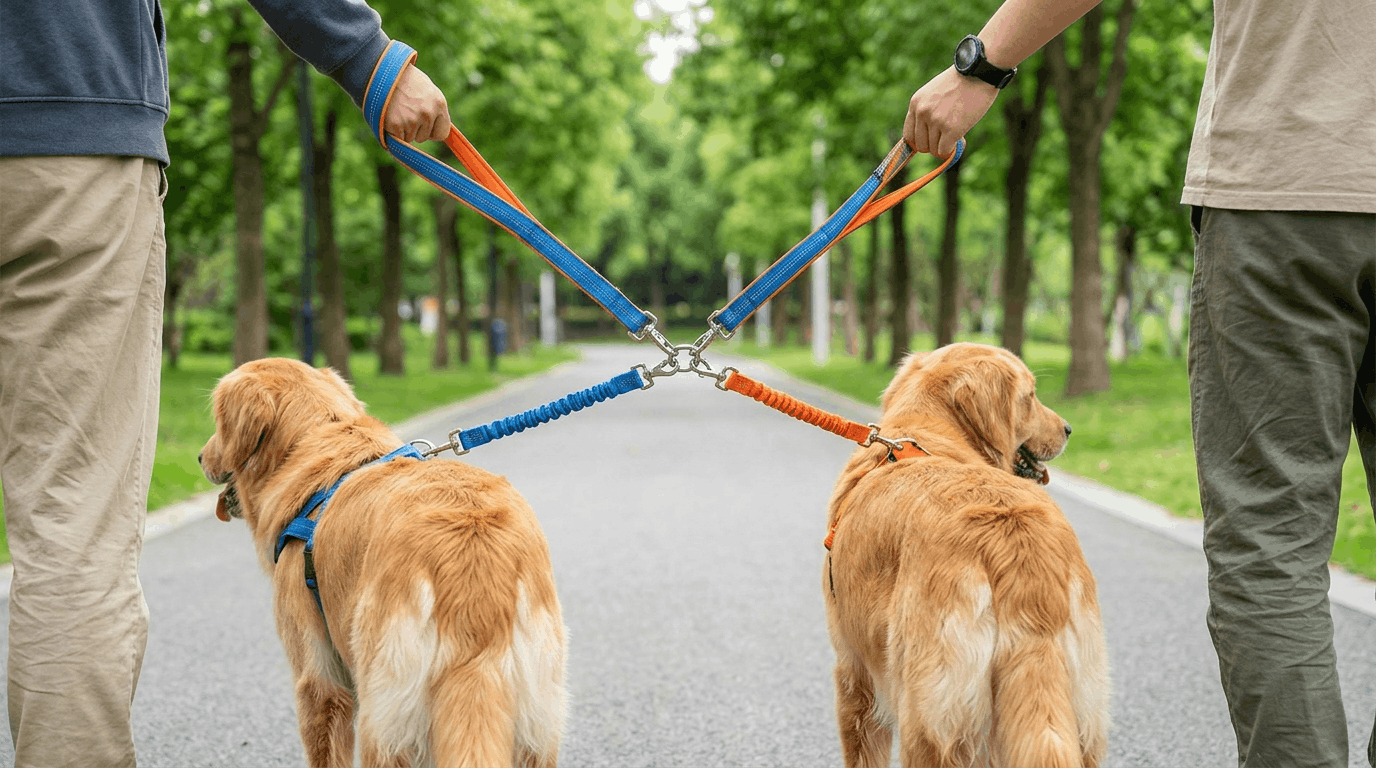
Choosing between a dual dog leash vs multiple leashes can feel confusing, especially if you want smoother and more controlled walks. Both options have clear advantages, yet the right choice depends on your dogs, your walking style, and how much control you need. While some owners prefer simplicity, others need flexibility. Understanding the differences helps you build a walking routine that feels balanced instead of stressful.
When you walk more than one dog, small details quickly matter. Leash tension, positioning, and movement all affect how the walk feels. Therefore, comparing a dual dog leash vs multiple leashes is not just about convenience. It is about creating a system that works consistently for both you and your dogs.
Understanding The Basics Of Each Option
A dual dog leash is designed to connect two dogs to a single handle. It usually includes a splitter or coupler that keeps both dogs attached to one central point. This setup simplifies handling and reduces the need to manage multiple grips. In contrast, multiple leashes involve holding separate leashes for each dog, typically one in each hand.
When comparing dual dog leash vs multiple leashes, the biggest difference is control versus simplicity. A dual leash offers a more streamlined experience, while separate leashes allow greater independence. Each approach can work well, depending on how your dogs behave during walks.
In addition, your comfort plays a role. Some owners prefer the ease of one handle, while others feel more secure with individual control. Therefore, the best choice often comes down to your specific needs and experience level.
Control And Flexibility During Walks
Control is one of the most important factors when deciding between a dual dog leash vs multiple leashes. With a dual leash, both dogs are connected, which keeps them close together. This can be helpful if your dogs walk at a similar pace and have calm behavior.
However, if one dog pulls or reacts differently, the connected setup can become challenging. The movement of one dog directly affects the other, which may create imbalance. In these situations, multiple leashes offer better flexibility. You can adjust each leash independently and respond to each dog’s behavior more effectively.
For example, if one dog needs correction while the other remains calm, separate leashes make it easier to manage. This added control is often the deciding factor in the dual dog leash vs multiple leashes comparison for many owners.
Ease Of Use And Convenience
Convenience is where a dual leash often stands out. Holding one handle feels simpler, especially for shorter walks or well-trained dogs. When both dogs move together, the experience becomes smooth and easy to manage.
On the other hand, multiple leashes require more coordination. You need to manage each leash separately, which can feel overwhelming at first. However, with practice, many owners find that the added control outweighs the initial challenge.
When evaluating dual dog leash vs multiple leashes, think about your daily routine. If you prefer a quick and simple setup, a dual leash may suit you better. If you prioritize control and adaptability, separate leashes may be the better option.
Managing Different Dog Personalities
Every dog has its own personality, and this plays a major role in choosing the right setup. Dogs with similar energy levels and walking styles tend to do well with a dual leash. They move together naturally, which reduces tension and keeps the walk balanced.
However, dogs with different behaviors may require more flexibility. For instance, if one dog is reactive while the other is calm, a dual leash can make the situation harder to control. In this case, multiple leashes allow you to manage each dog individually.
Therefore, when comparing dual dog leash vs multiple leashes, consider how your dogs interact. Matching the setup to their personalities improves both safety and comfort.
Preventing Tangling And Maintaining Order
Leash tangling is a common concern when walking multiple dogs. A dual leash helps reduce tangling by keeping dogs aligned. Since both dogs are connected, they are less likely to cross paths frequently.
However, this only works well if the dogs stay in position. If they move unpredictably, tangling can still occur. Multiple leashes, while more flexible, may require more attention to prevent crossing.
When deciding between dual dog leash vs multiple leashes, think about how well your dogs stay in place. Dogs that follow consistent positions benefit from a dual leash, while more active dogs may need the freedom of separate leashes.
Physical Comfort And Strain
Walking multiple dogs can put strain on your body, especially if they pull or move suddenly. A dual leash distributes force through a single handle, which can feel easier on your hands. However, it also combines the pulling force of both dogs.
If both dogs pull at the same time, the strain can increase significantly. In contrast, multiple leashes allow you to balance force between both hands. This can reduce pressure and improve overall comfort.
When comparing dual dog leash vs multiple leashes, consider how your body feels during walks. Comfort is just as important as control, especially for longer outings.
Training And Behavior Development
Training plays a key role in how effective each setup is. A dual leash can encourage dogs to move together, which supports consistent behavior. However, it may limit your ability to correct individual actions.
Multiple leashes provide more opportunities for targeted training. You can reward or correct each dog separately, which helps reinforce specific behaviors. This makes training more precise and effective over time.
Therefore, in the dual dog leash vs multiple leashes comparison, training goals should influence your decision. If you are actively working on behavior, separate leashes may offer better results.
When To Choose A Dual Dog Leash
A dual leash works best when your dogs are well-trained and have similar walking habits. If both dogs walk calmly and stay in position, this setup simplifies the experience. It is especially useful for short walks or low-distraction environments.
In addition, a dual leash is ideal for owners who prefer convenience. Managing one handle reduces complexity and allows for a more relaxed walk. However, this option requires consistency in your dogs’ behavior.
When considering dual dog leash vs multiple leashes, choose a dual leash if your dogs already walk well together and do not require constant adjustment.
When Multiple Leashes Are The Better Choice
Multiple leashes are often the better choice for dogs with different needs. If one dog pulls, reacts, or moves unpredictably, separate leashes give you more control. This flexibility makes it easier to handle challenging situations.
In addition, multiple leashes are ideal for training. You can focus on each dog individually, which helps improve behavior more effectively. Over time, this leads to better walking habits.
When comparing dual dog leash vs multiple leashes, choose separate leashes if control and adaptability are your priorities.
Conclusion
Deciding between a dual dog leash vs multiple leashes depends on your dogs, your preferences, and your walking goals. Both options have clear benefits, yet neither is perfect for every situation. A dual leash offers simplicity and alignment, while multiple leashes provide control and flexibility.
By understanding your dogs’ behavior and matching your setup to their needs, you create a more balanced walking experience. Over time, the right choice makes walks smoother, more enjoyable, and less stressful. Whether you choose a dual leash or separate leashes, the key is consistency, awareness, and a system that works for you and your dogs.
FAQ
- Which option is easier for beginners?
A dual leash is often easier to manage at first because it simplifies handling with one grip. - Can I switch between both setups?
Yes, many owners switch depending on the situation and their dogs’ behavior. - Are dual leashes good for large dogs?
They can work, but strong pullers may require separate leashes for better control. - Do multiple leashes reduce pulling?
They can help by allowing individual correction and better management of each dog. - What is the safest option overall?
The safest option depends on your dogs’ behavior, but control and comfort should always guide your choice.

